Introduction
I’m an integrative psychotherapist. My training spans psychoanalytic, person-centred, and existential approaches, and over the years I’ve layered in neuro-affirming practices, somatic work, mindfulness and symbolic tools like tarot. When I use tarot, it’s not about fortune-telling or mystical powers. It’s about reflection. It’s about noticing patterns, feelings, or thoughts that might not surface otherwise. It’s a tool to help people look at their own story from a slightly different angle.
Tarot as a Mirror, Not a Map
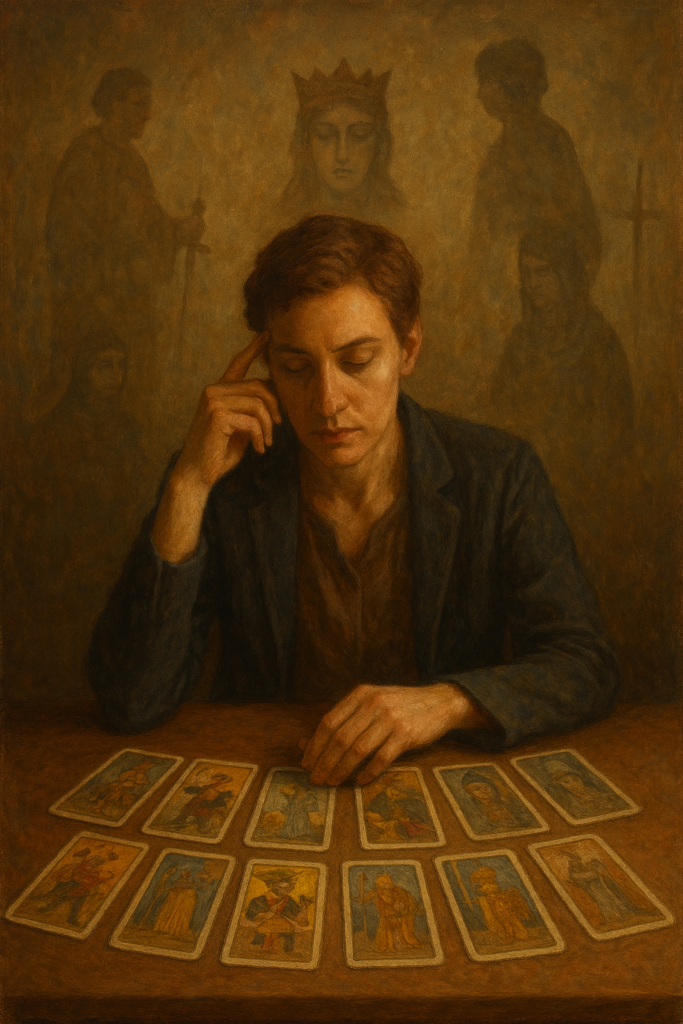
Tarot works as a mirror, not a map. You lay out a card, something resonates or sometimes irritates, and that’s your projection, your inner material coming to the surface. That’s what makes it interesting. It’s structured ambiguity. The images give you something to respond to, to think with, to reflect on.
This isn’t unique to tarot. Psychotherapy already uses projection, metaphor, narrative, and imagery all the time. Dream analysis, guided imagery, expressive writing, parts work, they’re all ways of engaging with material that is already meaningful but not fully conscious. Tarot just gives you one more symbolic medium for doing that.
The Psychoanalytic Angle
From a psychoanalytic perspective, tarot can act as a projective surface. What shows up in your responses, what you notice, what you ignore, what you feel drawn to can reveal internal dynamics, defences, or unresolved conflicts. Tarot doesn’t interpret you. You do, with a little guidance. It’s a conversation with your unconscious, but one that stays safely contained.
Jungian Symbolism and Archetypes
From a Jungian point of view, the deck contains archetypal imagery. The Fool, the Magician, and the Hermit are not literal characters. They’re recurring human motifs, patterns of experience. Interacting with these symbols is like active imagination. You notice patterns, you dialogue with inner aspects, you integrate what surfaces. That process is at the heart of individuation, growing into a fuller understanding of yourself.
Integrative Practice and Ethical Framing
I’m not tied to any one doctrine. Tarot is just one tool among many, alongside somatic work, mindfulness and neuro-affirming practices. Its use is always voluntary and interest-aligned. The client’s associations and reflections come first. And the focus is always reflective, never predictive.
Symbolic thinking doesn’t compete with evidence-based therapy. It’s another way of helping people make meaning, understand themselves, and explore internal patterns. When used responsibly, tarot can deepen reflection and offer insight without ever replacing therapeutic intervention.
Methodology and Scope
This is a conceptual discussion, not an empirical study. It draws on well-established literature about projection, narrative identity, and symbolic processing. It applies these frameworks to the reflective use of tarot in therapy. I’m not claiming tarot has clinical efficacy, nor is it a substitute for evidence-based treatment. The goal is clarity, ethical positioning, and articulating how symbolic tools can support reflection.
Conclusion
Tarot is not therapy, diagnosis, or assessment. But in a clearly framed, reflective context, it can act as a symbolic mirror. It helps people notice their own patterns, evoke insight, and engage with internal material safely. Its value depends on how responsibly the practitioner holds the space. With clarity, containment, and ethical use, symbolic tools like tarot can enrich integrative psychotherapeutic practice.
References
Freud, S. (1911). Psycho-analytic notes on an autobiographical account of a case of paranoia (Dementia Paranoides). Standard Edition, 12, 1–82.
Greenberg, L. S. (2017). Emotion-focused therapy of depression. Journal of Clinical Psychology, 73(10), 1289–1303.
Jung, C. G. (1959). The Archetypes and the Collective Unconscious (Collected Works Vol. 9, Part 1). Princeton University Press.
Jung, C. G. (1964). Man and His Symbols. London: Aldus Books.
Jung, C. G. (1966). The Practice of Psychotherapy (Collected Works Vol. 16). Princeton University Press.
Jung, C. G. (1969). Aion: Researches into the Phenomenology of the Self (Collected Works Vol. 9, Part 2). Princeton University Press.
Laplanche, J., & Pontalis, J.-B. (1973). The Language of Psycho-Analysis. London: Hogarth Press.
Lilienfeld, S. O., Wood, J. M., & Garb, H. N. (2000). The scientific status of projective techniques. Psychological Science in the Public Interest, 1(2), 27–66.
Frank, L. K. (1939). Projective methods for the study of personality. The Journal of Psychology, 8(2), 389–413.
Norcross, J. C., & Goldfried, M. R. (Eds.). (2019). Handbook of Psychotherapy Integration (3rd ed.). Oxford University Press.
McAdams, D. P., & McLean, K. C. (2013). Narrative identity. Current Directions in Psychological Science, 22(3), 233–238.