If you’ve ever thought:
There is nothing wrong with you.
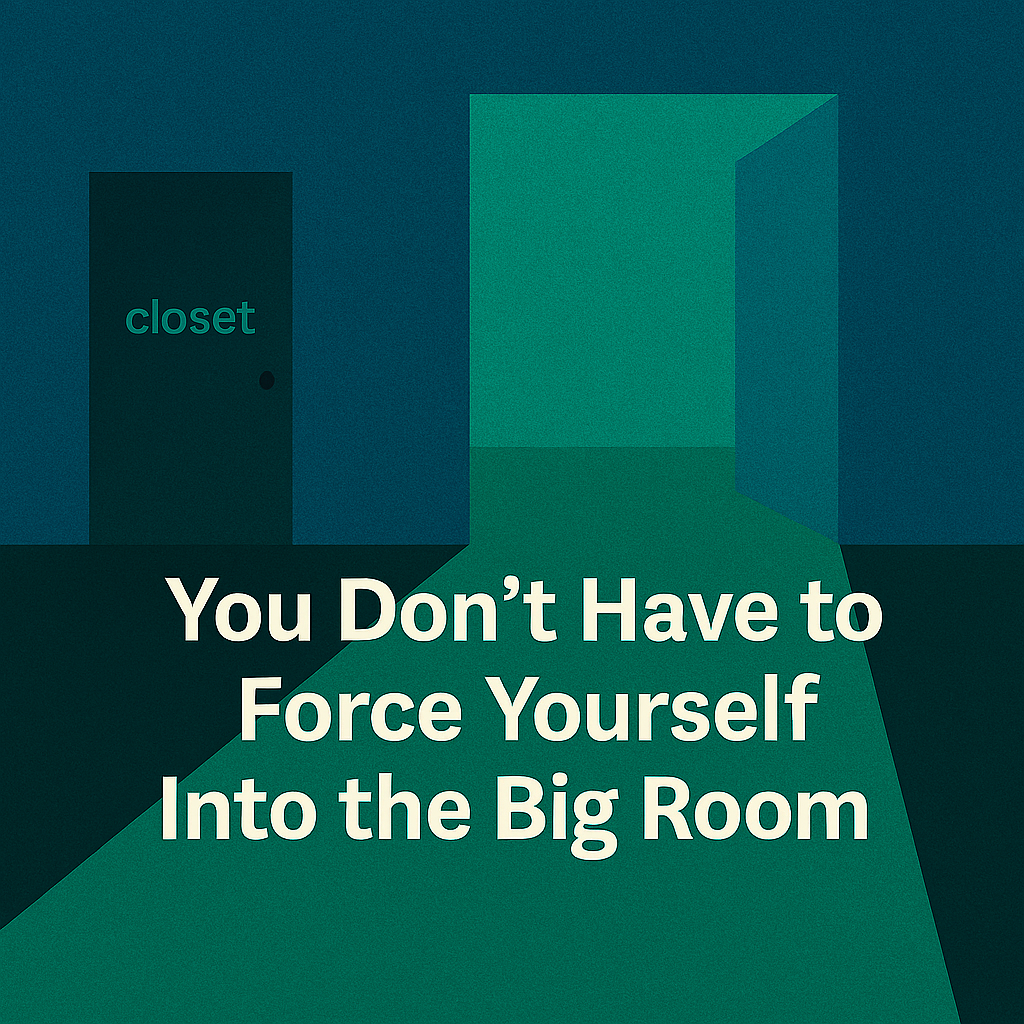
Here’s an analogy I often use.
Imagine your life as a house.
For many people who have lived through trauma, the big room hasn’t been safe for a long time.
It held:
So you adapted. You stepped into the closet. Not because you were avoiding life, but because your nervous system was protecting you.
That matters.
When someone is still under threat emotionally, relationally, financially, or physically, asking them to fully inhabit the present moment can actually increase distress.
Grounding yourself in a moment that feels dangerous doesn’t magically make it safe. Sometimes it does the opposite: it amplifies fear.
This is why many trauma survivors say grounding “doesn’t work,” not because they’re doing it wrong, but because the timing is wrong.
Healing doesn’t require forcing yourself back into the big room. Instead, it often looks like being adjacent to the present.
That means:
Things like imagination, creativity, tarot, stories, future planning, gentle escapism, or humour aren’t failures of therapy. In the right doses, they are bridges back to safety.
You’re not abandoning the present. You’re approaching it slowly.
There’s a quiet kind of regulation that comes from humility, from saying:
“I don’t need to understand everything right now.”
You don’t need to solve your whole life.
You don’t need certainty.
You don’t need to be perfectly present.
Letting go of those demands often calms the nervous system more than any technique.
Eventually, as safety becomes more consistent, not perfect, just reliable, something shifts.
You might notice:
Over time, your system learns:
“The big room isn’t what it used to be.”
And one day, without forcing it, you find yourself spending more time there.
That’s how healing actually happens.
In my practice, we don’t rush people into presence.
We work with:
We pay attention to what your nervous system needs now, not what it should be able to tolerate.
Sometimes grounding means breathing into your body.
Sometimes it means imagining a future that feels safer.
Sometimes it means stepping back, and that’s okay.
You don’t heal by dragging yourself into the big room.
You heal by letting yourself enter when your system says yes.
(These ideas are also shaped by lived experience and years of clinical practice.)